Showing posts with label impression. Show all posts

Thursday, January 23, 2014

Special Post: Men's Civilian Attire (England)

     I do not envy men when it comes to wartime civilian attire. They certainly have a worse time of finding information, and tend to wear their clothes out (alas, far fewer original pieces can be found!). To that end, I will try to offer as much information as I can with what resources I have. As with any impression, finding original images and footage is the absolute best way to go about figuring out what to look for when recreating a look. Catalogues are also a good resource, and I will pull a few of those as example images.
     This post in particular will be directed to fashions for men in England during WWII. American fashions and English fashions for men differed quite significantly during the war. As the US wasn't affected by rationing, enlistment, and war work until much later than England, there were more carry-over styles from the 30's and restrictions on Brits during the War. You'll notice a lot of these images are of the Home Guard, which was made up of men who were aged out of enlisted service. These were some of the only men not usually in uniform! Even the Home Guard was eventually outfitted with standard issue uniforms later on in the war, so photos of men in civilian attire in England specifically are a bit scarce.

     I've recently (as in, today) acquired a WONDERFUL book on wartime style, "The 1940's Look" by Mike Brown which I may paraphrase and quote occasionally (he IS a Brit, and a man, so he has a very relevant perspective to this post!).

The Basics - Suits, Trousers, Waistcoats, Shirts, and Sweaters


      From a video from the Imperial War Museum about the 1940's house, which touches on fashions for men, "Most men would have had two work suits, a Sunday best suit (or for funerals and weddings), and a sports jacket and flannels for the weekend. In 1942, the Board of Trade announced that all men's jackets were to be single breasted from now on, and limited to three buttons. Turn-ups on trousers were banned completely, a move that was extremely unpopular (and questions were even asked in the House of Commons about it)." This seems to refer to NEW garments, so I suppose if you still had a double breasted jacket or trousers with turn-ups (cuffs), you would be taking good care of them to keep them around as long as possible before having to give in and buy a new suit. However,

Tuesday, January 7, 2014

"In the Field" with Me - Episode 1: A tale of two pair of ebay heels

     I thought I would begin putting some of my advice into practice and sharing my own "in the field" wardrobe hunting experiences with you. What better way to begin than with something I have already talked about at length? Shoes!

I am ever searching the web for items for my various impressions, so as I was perusing ebay recently I came across a couple of listings I found interesting and worth sharing.

Exhibit A: "VTG 40s 50s SUZI CHRISTI Pinup Leather Slingback PeepToe Boho Rockabilly 10.5B"


A typical result when searching "40's vintage heels."

Look pretty nice, eh? Leather, 40's, slingback, peep-toe. . . they even say pinup! BUT let's look a little more closely. . . 

Sunday, August 4, 2013

First Impressions - An Introduction and Tips

Choosing an impression is a very personal experience, but one of the most important things to consider when getting into the hobby. Some impressions are easier (and cheaper) and some impressions are much more difficult (and expensive). My personal recommendation is to start with something simple, and then work your way into what suits your needs and interests. I will (and have) likely touch on this in many other posts, but everything boils down to and is effected by your impression and what you want to do/how you want to look.

So, I've decided to do a series of posts about different impressions starting with civilian all the way through military impressions. But first. . .

Some Tips


  • I like to think of impressions as sort of a role playing experience, where I ask myself, "If I were ________ in ________, what would I do/wear/be?" 
  • Related to the above, sometimes it helps to do an impression that suits your real life persona. For example, if you're a nurse, then be a nurse! I do photography, so I do a War Correspondent Photographer impression. It makes it that much more real for spectators when you actually know what you're talking about. That's not saying if you aren't really a nurse you can't be one, or that if you ARE really a nurse that you HAVE to be one. It's just a suggestion of a place to start where you will already be on familiar ground. 
  • You're not limited to one! Never feel like you have to always do the same thing at every event. That being said. . . 
  • Always choose an impression that is right for the event. If the event is in England in 1942, a female Russian military impression isn't going to really gel. 
  • Choose something doable. If your budget doesn't allow for purchasing a complete military uniform straight off, then definitely don't pick it as a first impression. 
  • Do your research! This becomes more important the more involved the impression is. Civilians were everywhere, so that's why I consider it the simplest. Research things about the year, the country the event is in, whether your unit (if you have one) would have been there. . . everything you can. It's also a good way to really "get in the mood" for the event the week(s) before.
  • Choose something you WANT to do. There is no substitute for genuine enthusiasm when it comes to getting into reenacting in general. If you choose an impression because it's convenient or you were told it's what you should do, you'll never really be happy with it, or worse, decide not to reenact at all. Which brings me to the biggest tip. . .
  • Have fun! Getting an impression together, especially when done with like-minded friends, can be loads of fun, only to be matched by the fun to be had at an event!


Wednesday, June 12, 2013

Shoes Part III - Let's Get Some Shoes!


The exciting trilogy conclusion to "Shoes Part I- Questions to ask yourself before purchasing" and "Shoes Part II- Original Examples and Characteristics"

SO, you've done all of your research and you're ready to go shoe shopping!
Let's pop on down to Belk and grab a pair!

If only it were that easy.

Actually on very very rare occasions, you may find some decent shoes at a retail shop. I have a pair that, though they came from a thrift shop, are modern "Sofft" brand shoes that are decently accurate (and croc embossed leather to boot!). But I'm here to talk more about options outside of that. There are more than you might think!

Tips on Identifying Originals "in the field"


Obviously, the very best way to have authentic looking shoes is to get actual shoes from the era. It gets bit tricky to distinguish some vintage shoes from one another, and truthfully some shoes from the 60's by all accounts look like shoes from the 40's. Just like today, it seems as though shoe stores still sold "out of style" older looking shoes for older people that still dressed that way! Or maybe shoes just didn't change that much. Either way I have seen "later" shoes that are passable as 40's. The important thing is to rely on your own judgment and research when shopping. A good tell for vintage shoes is the INSIDE. If it has a modern looking inside, with lots of colors and insole shaping and such, they're modern. Shoes from the 40's typically have a very simple liner that may or may not be stamped with a maker or shoe store, sometimes in gold foil. Most of the time this label has long since worn off, and you're left with a thin leather liner piece (usually the same color as the shoes) at the bottom, or no liner at all! This DID continue on into the 50's and 60's, with insoles getting more decorative and colorful, and makers marks getting more complicated. A good tip would be to make a little album of original pictures or notes that you can reference on your phone. That way, when you're out shopping and you think you've found something that will work, you can whip out your reference images and compare.

Places to shop!

Thrift Shops/Antique Stores/Flea Markets

By far the cheapest way to find some good shoes is to purchase secondhand. It is also the most time-consuming. HOWEVER, it's also the best way to pick up most of what you'll need for a civilian impression, so it my well be worth it to go bargain hunting! Goodwill's shoes are always the same price no matter what, local thrift stores tend to be the least picked over by vintage fashion wearers, especially if they're ones that only people "in the know" know about. Ask around! Antique Stores will be a bit more pricey, but also a bit more curated. You'll be more likely to actually find real vintage shoes, but may have to pay $10 more for them. Flea Markets are a bit hit or miss, since they're a little bit of everything. In my experience, people who specialize in clothing don't go to Flea Markets as much to set up, since it's a lot to transport for less money to be made than say, collectible glassware or furniture. That doesn't mean you should rule them out!

Etsy/Ebay

Same rules as thrift and antique store shopping apply to etsy and ebay shopping, only you have to be more careful. In short, a search for "1940's shoes" will turn up a lot of shoes that are not. Just because a listing claims shoes are 1930's or 1940's does not mean they are. Some people list things that are vaguely 1940's style, some people tag things as 1940's because the shoes are not a definitive style and they want to include all the options, and. . . some people don't know what they're talking about. Don't get me wrong! Most sellers deal in all eras of clothing, so they're simply not into one particular era enough to be able to distinguish between them easily. But it does mean you have to question whether something is authentic even when it's seemingly trustworthy.

Dance Stores

A good basic shoe for reenacting is a "character" shoe that is made for theater, ballroom, and swing dancing. In fact, swing dancing shoes especially are even made to look 40's! The most basic option is called a "character shoe" and makes for a decently priced plain black shoe. Also, being dance shoes, they are made to be quite comfortable! The only downside to these is that, being made for dancing, they have smooth bottoms for dance floors and wouldn't be very suitable for grassy/rocky on-site events (unless they are made with "street soles"and are labeled as such). Also, not all character shoes have a very authentic look, but most are quite good. They have T-strap styles as well that, though they would have been going out of style in the US at the time, are still very nice (especially for early war events or non-American impressions).
Sansha suede Flemenco shoes
$54.25 from Discount Dance
Theatricals "Baby Louis" Character shoes
Downside- faux leather  Upside- good price
$24.55 at Discount Dance

Aris Allen in particular has some very good swing dance shoes that are actually modeled after originals!

Aris Allen 3 Buckle Velvet
$69.95 at Dance Store. Also comes in brown.
Aris Allen Mesh Peep-Toe
$59.95 at Dance Store. Also comes in all black and all white.
Aris Allen Velvet and Mesh Mary Janes
$64.95 at Dance Store. Also comes in black and white and indigo and white.
Aris Allen Peep Toe Nubuck Mary Janes
$79.95 at Dance Store
1930's style Aris Allen Velvet Oxford
$54.95 at Dance Store. Also comes in black, tan, and fuchsia.
Also, they have a Sale Page.

More options. . .

Friday, June 7, 2013

Shoes Part II - Original Examples and Characteristics


The follow-up to "Shoes Part I- Questions to ask yourself before purchasing"

Heel Shapes

There are certain heel shapes to look for when searching for WWII appropriate shoes.

Flat - the basic flat oxford type heel similar to a man's shoe, which are good for practical hard working shoes like that of a Land Girl.
Wedge - or "wedgie" as they were called. More of a parallell platform wedge than a modern shaped wedge, they're a good heel type for both light work outfits like "Rosies" or factory girls, AND on the town outfits.
Heels - the general heel shape of the 40's heel was chunky, but shapely (the "cuban" heel was popular). An early form of the stiletto and kitten heels came about in the 50's, and the very shapely low heels were more 20's/30's. That being said, there are also some fairly crazy heels in fancy shoes of the WWII, but I would suggest avoiding them unless you are doing some serious dressing up, as they were more of a couture statement that few civilians would have had.

Toe Shapes and Straps

In general, the toe shape of all shoes was very natural and in the shape of the foot. I consider it a "normal" toe shape. I have yet to see examples of the extreme round toes or pointed toes we see in modern footwear, so try to avoid these. Shoes were either close-toed or peep-toed, with peep toe shoes having very little of the actual foot exposed, and increasing in popularity in later war years on into the 1950's. My personal rule of thumb is that it should have around a quarter's width opening (or smaller) for the toes to peep from. This isn't an absolute rule, but peep toe shoes regained popularity in the 60's with a much more open toe and it can help you distinguish between eras if you're looking at vintage shoes. T-stap shoes would have been a bit out of date by then, having been popular in the 20's and early 30's. Sling back straps were common, especially with wedge shoes. Lace-up shoes, too, are seen often, especially on oxfords and practical everyday shoes where a bit more protection on the top of the foot is desired or in fall/winter.

Materials

They got very creative during WWII with materials to make up for what was needed for the war effort. Leather shoes were harder to come by, so if you had a good sturdy pre-war pair, you did your absolute best to keep them in top condition, as you weren't likely to be able to purchase more. Exotic skins like alligator and crocodile became popular, as they were obviously an alternative leather that was NOT used for the war effort. They also used meshes, various fabrics for slippers and fine shoes, wools, velvets, and other natural materials. Heels were often cork or wood. The main thing to remember is stay away from synthetics if you can. If you find a good cheap pair of a leather or croc lookalike (high quality lookalike, as in you can't tell that it isn't leather if not for the inner label) that you'd like to wear for knocking about in at "iffy" events, then that's fine, but in general fakey plasticy materials are very much not 40's appropriate. In my experience, synthetics also make your feet sweat, break down faster, and are just all around suckier than natural materials.

Other Types of Shoes

Sandals existed, but mainly for beach and vacation wear (in truth, I have encountered very few of them, original or photos). Rubber boots were around too. They were plain black and used mainly for hard work; rubber being scarce and needed for the war effort, these were another rare commodity. In England, Land Girls were issued rubber boots, but most people would not have access to them unless they were hanging on to a prewar pair. Saddle shoes were already gaining popularity with the younger generation during the later part of WWII. They're not just for 50's sock-hops! However, they were generally seen being worn with playsuits, pants, or other "casual" clothing, rather than with nice frocks. Also, they are an example of a type of shoe mainly worn by the 25 and under crowd, so also keep in mind what would be age appropriate when selecting shoes. There were rain and winter rubberized "booties" that looked like a fashion shoe, but in rubber. Unfortunately, these are quite rare as there are no reproductions being made (that I know of), and original examples have either broken down over time or are ENORMOUSLY expensive. Not that you would want wear originals in the snow and rain and ruin them even if they were affordable!
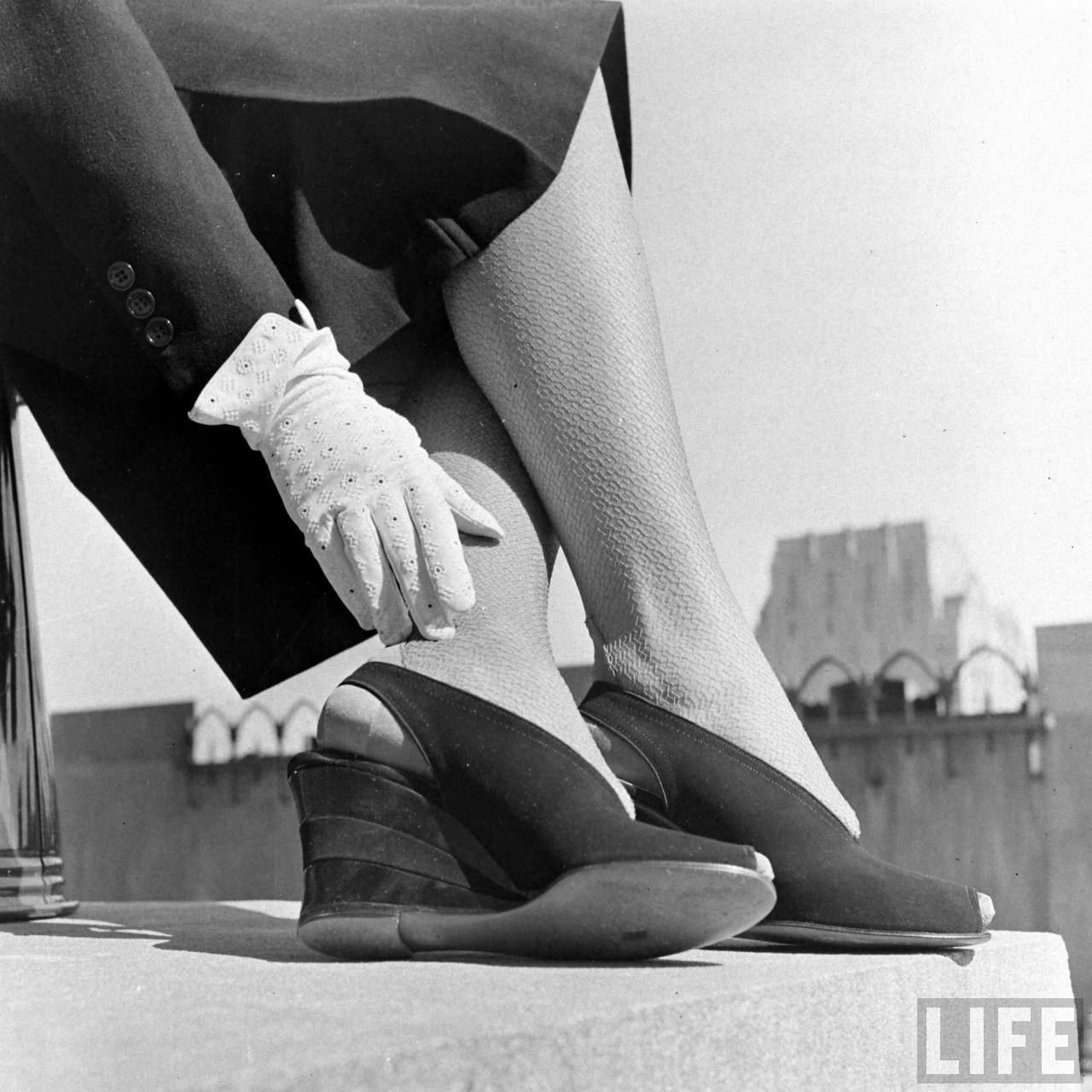
A good example of a fancy high wedge.
Note the tiny peep toe and the sling back strap.
More images. . .

Thursday, June 6, 2013

Shoes Part I - Questions to ask yourself before purchasing


So, this first post is going to be about shoes because admittedly. . . One of the very first things that I thought when I was considering doing a WWII Civilian impression was, "What am I going to wear on my feet?"

The right shoes can decidedly make or break the authenticity of your look, so it's a very important decision finding the right ones that work for you. After all, you'll be walking in them all day, whether it be the smooth tarmac of an air show or the rocky terrain of an on site event. You may even decide to build the rest of your impression around your shoes!

There are three very important questions to consider when looking for shoes:

1- Are they comfortable? 

A good indicator is knowing what kinds of modern shoes you are comfortable wearing. Just like today, there were a variety of heel heights and styles. You want to select something that will be comfortable for you to wear all day.

2- Do they work for you environment? 

Not all events are created equal. If you're mostly going to air shows, you can wear almost any type of heel or shoe you like, but at an on-site event things aren't quite so straightforward. It may be rocky or muddy or uneven steep terrain or high grass or. . . Anything! If you know where you will be wearing them and what the location is like, you have a good start to knowing what types of shoes will be the most practical for you.
As an example, I frequent an event that is all of the above horrendous conditions at different times (it even snowed once!). My first time out I took my original 40's black leather heeled oxfords out to wear and spent the whole time worrying and fussing and being extra careful of them. That's no fun at all! Now those are relegated to "nice" events and I wear some decent repro shoes I don't worry about so much for those "iffy" events. Or, if I don't know, bring both pairs and see which I feel like wearing after seeing what it's like.

3- Do they work for your impression? 

Obviously, a basic civilian impression has the most freedom here, especially a US civilian (European civilans had a more limited supply of shoes with rationing and whatnot and their shoes tended to be more practical, but the differences in US and European civilians is a discussion for another time). If you are a "Rosie" type factory girl impression, you wouldn't be wearing a 4 inch heel. A more practical closed toe lower heeled shoe makes more sense. Likewise if you're dressed to go "out on the town" a low boring practical shoe seems most dull. That being said, there are shoes that work fine for both, but that it a personal decision you have to make after seeing the options. If you are doing a military impression, that's yet again a discussion for another time, as they had regulation footwear for most female military personel.

Original WWII era poster  ©IWA London

One more thing! 

I'll touch on this more than once I'm sure, but something to keep in mind when googling for shoes (or anything else WWII fashion related, for that matter), is to be sure to know the DATE of what you're looking at. Bear in mind that the war ended in 1945, so just searching for "1940's shoes" may yield results that are later 40's. After the war, style in general exploded and changed, so a later shoe may not be appropriate. After you get more familiar with era correct shoes, you'll be able to determine just by looking at them. But if you're just starting out, I recommend trying to find CLEARLY DATED photos and museum pictures of originals to look at. In fact, in most places affected by the war, women were wearing prewar shoes most of the time. Rationing made shoes a rare commodity, especially in England where they cost 7 of your 48 clothing points for the entire year. This means it can actually be more applicable to look at late 1930's shoes for a daytime civilian impression, since women were more likely to be wearing their older shoes for everyday.

Up next: "Shoes Part II - Original Examples and Characteristics"  & "Shoes Part III - Let's Get Some Shoes!"

Until then, check out my "Fabulous Fighting Forties" Pinterest board.